
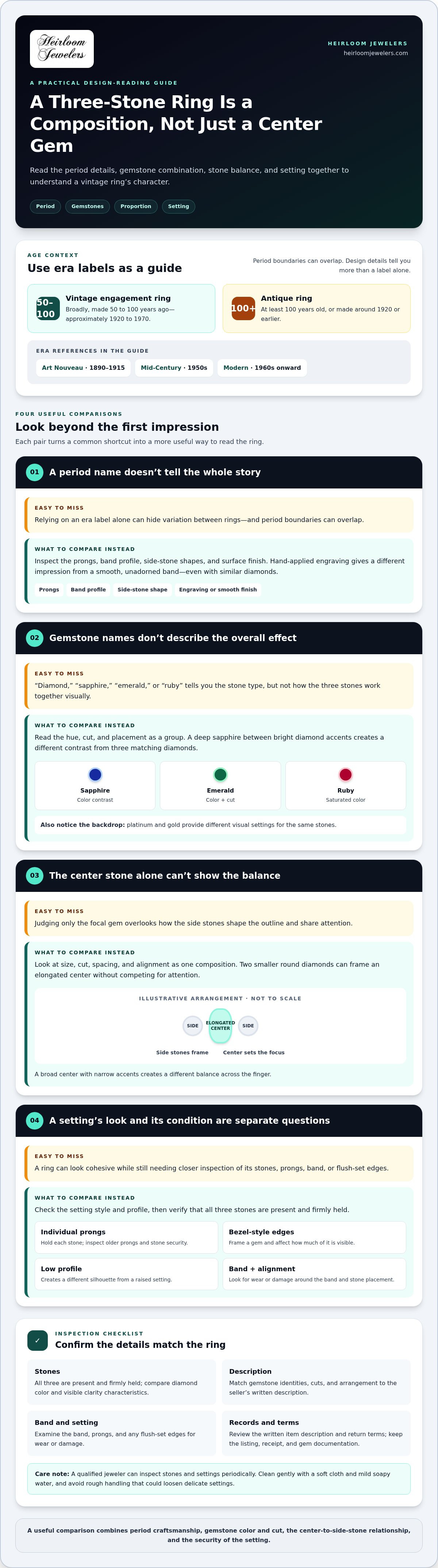
A three-stone ring pairs a center gem with two side stones, while its setting and gemstone combination give the design its distinctive character. Vintage three-stone rings can range from understated diamond trios to colorful arrangements shaped by the craftsmanship of their period. Broadly, a vintage engagement ring was made 50 to 100 years ago, approximately from 1920 to 1970; an antique ring is at least 100 years old, or was made around 1920 or earlier.
It’s easy to focus on the center stone, but the side stones, setting, and period details matter just as much to a ring’s overall look. This guide explains how vintage and antique styles differ, what diamonds, sapphires, emeralds, and rubies bring to a three-stone design, and how the balance between center and side stones shapes its appearance. You’ll also learn which setting details to compare, so you can better understand each ring’s character and craftsmanship.
Key Takeaways
- Compare the ring’s period details and setting style to understand the design character you’re drawn to.
- Assess how diamonds and colored gemstones shape the ring’s contrast, mood, and visual balance.
- Look at the center stone and side stones together; their relative size, shape, and placement define the arrangement.
- Consider how gemstone color and setting details work together rather than judging each feature on its own.
- Use the distinction between vintage and antique as a starting point when exploring a ring’s age and historical style.
Vintage three-stone engagement ring styles
Period details, stone shapes, and setting construction distinguish one vintage three stone ring from another. Compare these features to see how a ring’s era influences its character.
Vintage and Modern Style Differences
Vintage designs often show period-specific craftsmanship, while modern styles commonly emphasize clean lines and a coordinated finish. Compare the prongs, band profile, and side-stone shapes, not just the center gem. Hand-applied engraving, for example, creates a different impression from a smooth, unadorned band, even when both rings hold similar diamonds.
Era names offer useful context, but they don’t describe every ring identically. Era boundaries can vary, so treat period labels as a guide rather than a precise description of every ring. Art Nouveau dates from 1890-1915, while Mid-Century designs belong to the 1950s. Modern styles date from the 1960s onwards. These periods overlap in dates, so examine the actual design details rather than relying on a label alone.
Gemstone and Setting Choices
Diamonds create a classic trio, while sapphires, emeralds, and rubies add color. Some rings pair a colored center stone with diamond side stones; others use three gems of the same kind. Consider how the stones’ color, cut, and visual weight relate. A deep sapphire between bright diamond accents looks different from three matching diamonds.
Common settings include individual prongs that hold each stone and bezel-style edges that frame a gem. The setting affects how much of each stone is visible and how the three appear together. Check the side profile, band, and stone alignment, then compare these details across rings. A low profile, for example, creates a different silhouette from a raised setting.
Ring size depends on the wearer, while resizing depends on the band’s construction. A plain shank is generally simpler to alter than one with continuous engraving or stones set around the band. Before purchasing, ask the seller to provide the ring’s size and any resizing terms in writing.
For care, have a qualified jeweler inspect the stones and settings periodically. Clean gently with a soft cloth and mild soapy water, and avoid rough handling that could loosen delicate settings. Pay particular attention to older prongs, since secure stone placement is essential to preserving the ring.
In the United States, choose an established vintage or estate jewelry retailer and review the written item description and return terms before paying. Keep the listing, receipt, and any gem documentation with your records. These materials clarify what the seller represented and what purchase protections are provided.
The collection describes three-stone engagement rings as available with classic diamond trios or combinations of colorful gemstones.
Diamond, sapphire, emerald, and ruby three-stone rings
When buying a vintage three-stone ring, inspect each gem, the setting, and the band for condition and consistency. Compare the written description with the ring itself, especially the stated stone identities and cuts, as well as any visible wear.
Diamond trios offer a unified look, but their stones need not be identical. Compare their color in the same lighting and check whether the center and side diamonds look harmonious. Clarity describes internal or surface characteristics; examine each stone for visible inclusions and note how their placement affects appearance. Old European cuts, found in vintage rings, have a different outline from modern round brilliant cuts. Matching is about visual balance, not simply choosing three stones with the same label.
Ruby and diamond combinations add strong color contrast. One Victorian Old Mine Cut diamond and ruby trilogy ring has a total weight of 2.13 carats. Another example pairs diamonds and rubies in a flush-set trilogy design. These examples show how cut and setting change the effect: an Old Mine Cut brings an older facet pattern, while flush settings place stones close to the band. For an engagement ring, look closely at how the ruby’s color relates to the diamonds and whether the stones sit securely.
Sapphire and diamond rings vary by period and construction. Emerald and diamond designs range from three-stone rings to Art Deco cluster arrangements. These styles are not interchangeable: a cluster groups stones closely, while a three-stone arrangement gives each gem a distinct position.
To compare colored-stone combinations, consider three features: hue, cut, and placement. A sapphire center with diamond side stones creates a different balance from three sapphires. Some emeralds have a step-cut look, while round diamond accents add contrast. Ruby and diamond pairings can emphasize the ruby’s saturated color. Metal matters, too: platinum and gold provide different visual backdrops for the same stones.
- Check that all three stones are present and firmly held in their settings.
- Compare diamond color and visible clarity characteristics across the trio.
- Examine the band, prongs, and any flush-set edges for wear or damage.
- Match the seller’s description to the gemstone types, cuts, and arrangement.
When assessing a three-stone engagement ring, these checks help you recognize a balanced design and spot details that need closer attention. A clear description of the center and side stones, paired with careful inspection of the setting, makes comparisons more useful than relying on gemstone names alone.
Center and side-stone arrangement
The center stone establishes the focal point, while the side stones shape its outline. Compare their size, cut, spacing, and alignment as one composition. Two smaller round diamonds, for example, can frame an elongated center without competing for attention. A broad center with narrow accents creates a different balance across the finger.
Relative size matters more than the number of stones. Side stones close to the center’s width can create a broad, continuous face, while smaller accents leave the center visually distinct. Compare a round center with tapered side stones against a marquise center with matching pointed accents. The first arrangement may feel softer; the second extends the ring’s length.
Shape also guides the eye. An emerald-cut center has straight lines and clipped corners, so tapered or step-cut side stones can continue its geometry. Round side stones create contrast. A marquise center draws attention along the finger, while round accents can soften its pointed ends. View the ring from above and from the side to assess both its face-up shape and profile.
Spacing and setting determine whether three gems read as a connected row or separate focal points. Close-set stones create a compact arrangement, while visible gaps give each gem more definition. Prongs can frame individual stones and leave their outlines visible. A flush-set design, such as a sapphire trilogy ring, places stones close to the band for a different profile. Compare how each setting changes the apparent distance between the gems.
Vintage arrangements may reflect the cuts available when a ring was made. Old European or Old Mine Cut diamonds can have different outlines from modern brilliant cuts. Pairing an antique-style center with side stones in another cut may create deliberate contrast or a less unified appearance. Check whether the side stones follow the center’s shape, repeat its facet character, or provide a clear counterpoint.
- View the ring straight on to compare the center’s width with both side stones.
- Check that paired side stones look balanced in shape, size, and position.
- Turn the ring sideways to see whether the settings sit at similar heights.
- Look for uneven spacing, tilted stones, or prongs that interrupt the arrangement.
Finally, consider how the arrangement sits on the hand. An elongated center with tapered sides directs the eye along the finger; a compact trio creates a wider visual span. Compare these effects from above. A well-balanced design has a clear focal stone, with side stones that support its shape rather than distract from it.
Three-stone ring design and gemstone combinations
Gemstone combinations change a three-stone ring’s visual rhythm. A matched trio creates continuity, while mixed gems give each position a distinct role. A sapphire center with diamond accents, for example, sets saturated color against bright contrast. Three sapphires instead make color the repeated motif. Compare hue, outline, and spacing together to judge whether the design feels unified or deliberately varied.
Cut can reinforce that contrast. A 2.66 carat Asscher Cut diamond and sapphire trilogy ring combines a square step-cut outline with a colored counterpart. The geometric shape gives the design a more structured impression than three round stones would. Notice whether the side gems echo the center’s outline or introduce a separate shape. Either approach can look intentional when the stones’ proportions remain visually balanced.
Color can also be the defining feature rather than the cut. One vintage color-change sapphire three-stone ring has a total weight of 12.50 carats. Its named gemstone brings a changing color quality to a design that might otherwise rely on diamond brilliance. In a mixed-stone ring, consider how the side stones relate to the central gem under different lighting. The contrast should help distinguish the three-stone arrangement, not make its parts appear unrelated.
Setting style alters the way a combination reads. A 2.90 carat total weight sapphire three-stone ring uses a flush setting, placing the gems close to the band. Another example, a 1.55 carat total weight diamond and ruby flush-set trilogy ring, combines two gem types in that construction. Compare these with raised settings: the height, visible metal, and edges around each stone affect the ring’s profile and how clearly each gem stands apart.
Metal choice adds another design consideration. Platinum and gold create different backdrops for the same gemstone colors. For a sapphire and diamond combination, consider how the metal looks alongside the cool-toned stones. With ruby and diamond, note how the band relates to the ruby’s color. Check the setting’s condition as well as its appearance, especially around older stones and the edges that hold them in place.
- Identify the center gem, side stones, and cuts before judging the combination.
- Compare color contrast in consistent lighting, then view the ring from above.
- Inspect how metal and setting shape the visible outline of each stone.
- Use examples such as Asscher-cut sapphire and diamond designs to compare geometric styles.
These comparisons help clarify what defines a design: repeated color, contrasting gems, geometric cuts, or a low-profile setting. Decide which feature matters most, then assess how the other details support it.
Vintage and antique engagement rings
Age labels are a starting point, but they don’t establish a ring’s history by themselves. Compare the stated period with the materials, construction, and design details to distinguish vintage and antique engagement rings from modern reproductions.
Authentic Vintage Ring Identification
A vintage engagement ring is broadly defined as 50 to 100 years old, approximately from 1920 to 1970. An antique engagement ring is at least 100 years old, or was made around 1920 or earlier. These are useful working definitions, not proof of a particular ring’s age. Look for several design and construction details that fit the same period.
For example, an Edwardian ring should be considered alongside the Edwardian era dates, 1901-1914. Compare its metalwork, setting, and stone cuts with its claimed history. A single old-fashioned detail can be copied, so look at the ring as a whole.
Recognizing Modern Reproductions
A modern reproduction may borrow the silhouette or ornament of an earlier ring. Check whether the finish, setting, and small details appear consistent with the claimed period. For instance, a ring described as Art Deco should be assessed against the era’s 1920-1935 dates and its overall geometric design, rather than one decorative feature alone.
Look for a written description stating whether the ring is vintage, antique, or a reproduction. Compare it with clear photographs of the setting, band, and underside. If details conflict, take a closer look before purchasing.
Period context can narrow the comparison. The Victorian and Art Nouveau eras overlap, so a style label alone cannot settle a ring’s age. Their dates overlap, so a style label alone cannot settle a ring’s age. Examine details such as the band’s profile, stone placement, and decorative work together.
Later designs provide another point of reference. Art Deco dates from 1920-1935, and the Retro era falls in the 1940s. A three-stone ring described as Retro should be evaluated through its full construction and design, not simply because it has a bold or rounded appearance.
Use a consistent review process before deciding:
- Compare the claimed era with its date range and design features.
- Inspect the setting, band, and underside in photographs or in person.
- Read the description for clear language about age and reproduction status.
- Keep the written description and purchase records with the ring.
For example, a 1920s-inspired ring is not necessarily an antique. The clearest assessment comes from matching the stated age, construction, and period details rather than relying on appearance alone.
Listings can offer useful comparison points, but a title and asking price do not establish a ring’s age or authenticity. Compare each description with the ring’s visible construction and review any supporting details.
Treat listings as references for comparing descriptions, not as substitutes for examining a specific ring’s period details and records.
Heirloom Jewelers: Lugano Emerald & Diamond Necklace 18K White Gold
Heirloom Jewelers offers the Lugano Emerald & Diamond Necklace 18K White Gold, a way to appreciate the contrast between emerald color and diamond accents. For a closer connection to the engagement-ring styles discussed here, consider the Vintage Platinum 0.5 Carat Diamond Engagement Ring. Its vintage character and platinum setting offer another point of comparison when considering period details and materials. The Vintage White Gold Old European Cut Diamond Stud Earrings also feature an historic diamond cut, while the Estate Peridot & Quartz Dangle Earrings 14K Yellow Gold offer a different gemstone pairing.
Explore these estate and vintage pieces at Heirloom Jewelers.
Choose a Ring That Feels Personal
The right ring should feel at home in your life, not simply reflect a period or gemstone trend. Vintage three-stone rings invite a personal choice: decide which detail matters most, whether it’s the character of an old cut, the contrast of colored gems, or the way the stones sit together. That preference can guide your search and help you recognize a design worth keeping.
Heirloom Jewelers offers estate and vintage pieces that bring different materials and histories into view. The Lugano Emerald & Diamond Necklace 18K White Gold pairs emeralds with diamonds; Vintage White Gold Old European Cut Diamond Stud Earrings highlight an antique diamond cut. For an engagement-ring option, consider the Vintage Platinum 0.5 Carat Diamond Engagement Ring. Each offers a distinct way to appreciate fine jewelry beyond a single design.
Let your priorities shape the next step. Contact Heirloom Jewelers about ring styles and continue your search with a clearer sense of what speaks to you.
Frequently Asked Questions
Which vintage eras and styles are popular for three-stone rings?
Edwardian, Art Deco, and Victorian designs are popular styles, each with distinct decorative cues. Edwardian rings often feature delicate filigree and milgrain, while Art Deco designs favor symmetry and crisp geometric accents. Victorian examples may have more ornate detailing. To narrow your preference, compare the band decoration and the details around each side stone, not just the center gem. These features help you identify the period character that suits your taste.
What ring sizes and resizing options are available for vintage three-stone rings?
Ring size depends on the wearer, and resizing depends on the band’s construction: a plain shank is generally easier to alter than one with continuous engraving or stones around the band. A complimentary resize is limited to up to 1.5 U.S. ring sizes; ask the seller to put the ring’s size and resizing terms in writing.