
An Etruscan Revival gold bracelet can draw attention for its historic style without being an ancient Etruscan object. Its appeal comes from details such as granulation, fine filigree, beading, and motifs inspired by archaeological discoveries in Italy. The style became especially popular in the 1860s and 1870s.
That distinction matters when assessing an Etruscan Revival gold bracelet. Gold content and condition are important, but craftsmanship, age, and decorative detail also shape how a piece is understood and appreciated. A richly textured surface, for example, can reflect considerable handwork even when the bracelet revives an older tradition.
This guide explains the features associated with Etruscan Revival jewelry and how to consider a bracelet’s materials, construction, condition, and visual appeal. Learn to recognize granulation and filigree, understand the role of motifs, and distinguish historical influence from a piece’s actual age. These details help you assess a bracelet beyond appearance alone.
Key Takeaways
- Separate a bracelet’s historical design influence from its actual age when considering its appeal.
- Assess gold content, construction, condition, and decorative details together rather than relying on appearance alone.
- Look closely at motifs and workmanship to understand what gives a piece its distinctive character.
- Explore estate and vintage jewelry through Heirloom Jewelers, including diamond, platinum, and gemstone pieces.
Etruscan Revival gold bracelet
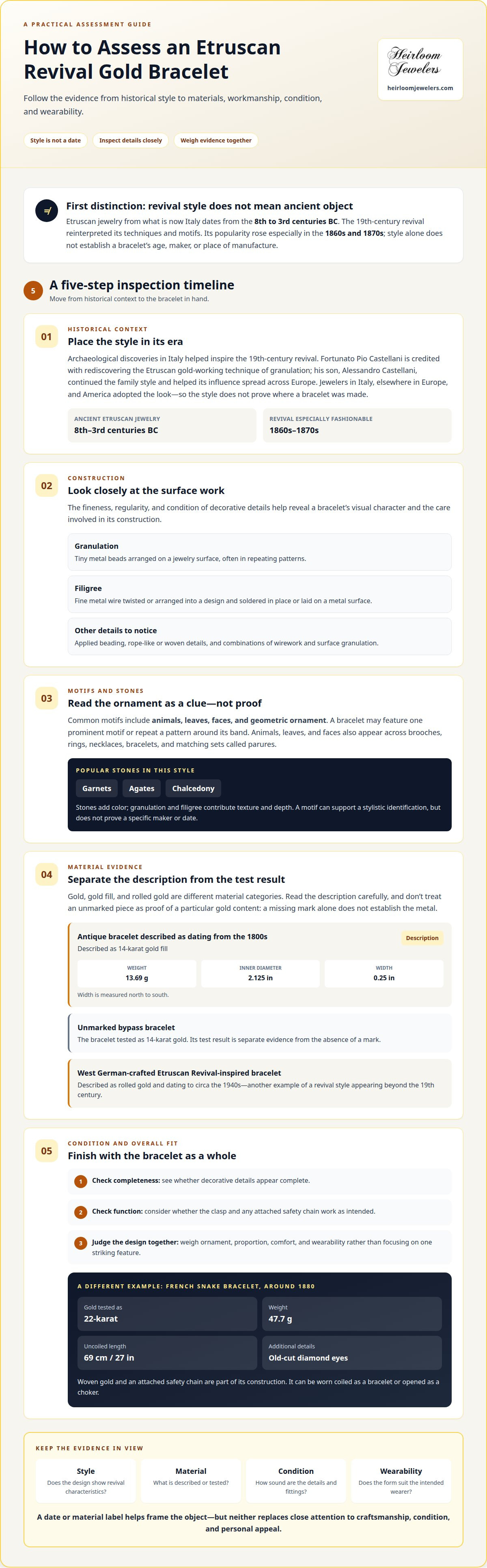
The name describes a bracelet shaped by the decorative language of ancient Etruscan jewellery, not necessarily an object made in ancient Etruria. Etruscan jewellery from what is now Italy dates from the 8th to 3rd centuries BC. The 19th-century revival reinterpreted its techniques and motifs for a later audience. That distinction is central when assessing age, workmanship, and appeal.
Archaeological discoveries in Italy helped inspire the revival, which became especially fashionable in the 1860s and 1870s. Fortunato Pio Castellani is credited with rediscovering the Etruscan gold-working technique of granulation. His son, Alessandro Castellani, continued the family’s style, helping its influence spread across Europe. Jewellers in Italy, other European countries, and America adopted the look, so the style alone does not establish where a bracelet was made.
Examine the surface closely. Granulation uses tiny metal beads arranged on a jewelry surface, often in repeating patterns. Filigree uses fine metal wire, twisted or arranged into a design and soldered in place. Beading, applied wirework, and rope-like or woven details may appear alongside these techniques. The fineness, regularity, and condition of the details reveal a piece’s visual character and the care involved in its construction.
Motifs offer another useful clue. Etruscan Revival pieces commonly feature animals, leaves, faces, and geometric ornament. A bracelet may showcase one prominent motif or repeat a pattern around its band. Garnets, agates, and chalcedony were also popular stones in this style. Consider how the metalwork and gemstones work together: stones add color, while granulation or filigree contributes texture and depth.
Use these steps to assess a bracelet’s style and appeal:
- Identify the construction. Look for granulation, filigree, applied beading, and woven or rope-like decoration.
- Read the material description carefully. Gold, gold fill, and rolled gold describe different material categories; don’t treat them as interchangeable.
- Observe the motif. An animal, leaf, or face can support a stylistic identification, but does not prove a specific maker or date.
- Consider condition. Check whether decorative details appear complete and whether the clasp or attached safety chain functions as intended.
- Judge the design as a whole. Weigh ornament, proportion, comfort, and wearability together rather than focusing on one striking feature.
Examples show why those distinctions matter. An antique bracelet described as dating from the 1800s is made of 14-karat gold fill, weighs 13.69 grams, and has an inner diameter of 2.125 inches. Its width measures 0.25 inches north to south. By contrast, an unmarked bypass bracelet has tested as 14-karat gold. These examples show that a missing mark does not by itself establish a bracelet’s metal content; material descriptions and test results are separate evidence.
A French snake bracelet dating to around 1880 offers a different combination of features. Its woven gold tests as 22-karat, and it weighs 47.7 grams. Old-cut diamonds form its eyes, and an attached safety chain adds a functional detail. At 69 centimetres, or 27 inches, uncoiled, it can be worn as a coiled bracelet or opened as a choker. The conversion and workmanship contribute to its distinct appeal.
For a considered assessment, separate four questions: does the design show revival characteristics, what material is described or tested, how sound are the details, and does the form suit the intended wearer? A date such as circa 1880 or a material description such as gold fill helps frame the object, but neither replaces close attention to craftsmanship and condition. This approach keeps historical style, physical evidence, and personal appeal in view together.
Examples show how a stylistic label can cover pieces with different descriptions. A West German-crafted Etruscan Revival-inspired rolled gold bracelet is described as dating to circa the 1940s, while the Antique 1800s Etruscan Revival Bracelet measures .25 inches north/south. A bracelet’s eyes are set with old cut diamonds. Such details belong in a description alongside any stylistic reading, rather than being inferred from ornament alone.
Filigree is made by twisting fine gold or metal wire and soldering it together or laying it on a metal surface to create a pattern. Etruscan Revival jewelry is characterized by applied filigree and beading, surface granulation, and motifs such as rope or weaving. Animal, leaf and face motifs appear on brooches, rings, necklaces and bracelets, and in matching sets called parures.
Heirloom Jewelers
For readers interested in vintage and estate jewelry, Heirloom Jewelers offers a curated collection of authenticated pieces. Its selection includes fine jewelry in varied metals and settings, making it possible to explore how materials, gemstones, and design come together across different periods.
For example, the Estate Peridot & Quartz Dangle Earrings 14K Yellow Gold pair two gemstones with a yellow-gold setting. The example is distinct from an Etruscan Revival bracelet, but it reflects the broader appeal of estate jewelry: individual materials and craftsmanship give each piece its character. Heirloom Jewelers also offers vintage diamond earrings and a vintage platinum engagement ring.
If you’d like to explore estate and vintage jewelry, contact Heirloom Jewelers.
Let Craftsmanship Guide Your Next Choice
A piece inspired by historic jewelry can hold meaning beyond its materials. What draws you to an Etruscan Revival gold bracelet may be its intricate surface, distinctive motif, or reflection of renewed interest in ancient craftsmanship. Let that personal response guide your search, alongside careful attention to the bracelet itself.
As you consider estate and vintage jewellery, notice which forms and materials continue to hold your interest. Heirloom Jewelers’ collection includes the Lugano Emerald & Diamond Necklace 18K White Gold, Vintage White Gold Old European Cut Diamond Stud Earrings, and Vintage Platinum 0.5 Carat Diamond Engagement Ring. Each offers another perspective on the character of fine jewelry from earlier eras.
Continue your exploration at a thoughtful pace, allowing craftsmanship and personal appeal to shape your choices. Contact Heirloom Jewelers to begin a conversation about estate and vintage jewelry.